

2x 2 7x 6 Factor
Factorization Of Polynomials Using Factor Theorem
Factor Theorem:
If p(x) is a polynomial of degree due north 1 and a is any real number, then (i) ten – a is a factor of p(x), if p(a) = 0, and (2) p(a) = 0, if x – a is a factor of p(x).
Proof: By the Remainder Theorem,
p(ten) = (x – a) q(ten) + p(a).
(i) If p(a) = 0, then p(x) = (10 – a) q(x), which shows that x – a is a factor of p(x).
(2) Since ten – a is a cistron of p(x),
p(10) = (ten – a) chiliad(10) for same polynomial yard(x). In this case, p(a) = (a – a) g(a) = 0.
- Obtain the polynomial p(x).
- Obtain the constant term in p(10) and detect its all possible factors. For example, in the polynomial
xiv + x3 – 7xtwo – x + 6 the constant term is vi and its factors are ± 1, ± 2, ± three, ± half-dozen. - Take i of the factors, say a and replace x by information technology in the given polynomial. If the polynomial reduces to zero, then (ten – a) is a factor of polynomial.
- Obtain the factors equal in no. to the degree of polynomial. Allow these are (x–a), (x–b), (x–c.)…..
- Write p(10) = thou (x–a) (x–b) (10–c) ….. where m is constant.
- Substitute any value of ten other than a,b,c …… and notice the value of 1000.
People also ask
- Segmentation algorithm for polynomials
- Algebraic Identities Of Polynomials
Factorization Of Polynomials Using Factor Theorem Example Problems With Solutions
Example 1:Factorize x2 +4 + 9 z2 + 4x – 6 xz – 12 z
Solution:
The presence of the three squares viz.x2, (2)2, and (3z)2 gives a inkling that identity (vii) could be used. So nosotros write.
A = x2 + (2)2 + (3z)ii + 4x – half-dozen xz – 12 z
We annotation that the concluding two of the product terms are negative and that both of these contain z. Hence we write A as
A = xtwo + (ii)2 + (–3z)2 + 2.2x – ii.x.(–3z) + 2.2 (– 3z)
= (ten+two – 3z)ii
= (x + 2 – 3z) (x + 2 – 3z)
Example 2: Using factor theorem, factorize the polynomial xiii – 6x2 + xi 10 – half-dozen.
Solution:
Permit f(x) = 10three – 6x2 + 11x – half dozen
The constant term in f(x) is equal to – 6 and factors of – 6 are ±1, ± two, ± 3, ± vi.
Putting 10 = i in f(x), we have
f(1) = i3 – six ×1ii + 11× 1– 6
= one – 6 + 11– 6 = 0
∴ (x– 1) is a gene of f(x)
Similarly, x – two and 10 – 3 are factors of f(x).
Since f(10) is a polynomial of degree iii. Then, it can not have more than three linear factors.
Let f(x) = k (ten–one) (x– 2) (x – 3). Then,
103– 6x2 + 11x – half dozen = k(x–one) (10– ii) (10– 3)
Putting x = 0 on both sides, nosotros get
– 6 = thousand (0 – 1) (0 – two) (0 – three)
⇒ – 6 = – half-dozen k ⇒ chiliad = one
Putting thousand = ane in f(10) = k (x– one) (x– two) (x–three), nosotros become
f(x) = (10–one) (x– two) (x – three)
Hence, x3–6x2 + 11x – 6 = (x– 1) (x – 2) (x–3)
Example three:Using factor theorem, factorize the polynomial ten4 + ten3 – 7x2 – x + 6.
Solution:
Let f(x) = xfour + xiii– 7x2 –x + 6
the factors of constant term in f(x) are ±1, ±2, ±three and ± 6
Now,

Since f(ten) is a polynomial of degree four. And so, information technology cannot accept more four linear factors
Thus, the factors of f (x) are (x–i), (10+i),
(10–two) and (10+3).
Let f(x) = k (x–1) (10+ane) (x–2) (x + 3)
⇒ 10four + xiii – 7xii – x + 6
= k (10–1) (ten +1) (10 – 2) (x + iii)
Putting x = 0 on both sides, we become
6 = grand (–1) (one) (–2) (iii) ⇒ 6 = six k ⇒ thousand = 1
Substituting grand = 1 in (i), nosotros go
10iv + xiii – 7x2 – ten + half-dozen = (x–1) (10 +ane) (x–two) (x+three)
Example 4:Factorize, 2xfour + x3 – 14x2 – 19x – vi
Solution:
Let f(x) = 2xfour + xiii – 14x2 – 19x – 6 be the given polynomial. The factors of the constant term – 6 are ±1, ±two, ±iii and ±half-dozen, we have,
f(–1) = 2(–1)4 + (–1)3 – 14(–1)two – xix(–1)– six
= ii – 1 – 14 + 19 – vi = 21 – 21 = 0
and,
f(–ii) = 2(–2)4 + (–2)iii – 14(–two)ii – xix(–2)– half-dozen
= 32 – 8 – 56 + 38 – 6 = 0
So, x + 1 and x + 2 are factors of f(x).
⇒ (x + 1) (ten + ii) is also a factor of f(x)
⇒ x2 + 3x + ii is a cistron of f(x)
Now, we split
f(x) = 2x4 +ten3 – 14x2–19x – half-dozen by
xtwo + 3x + 2 to become the other factors.

Case 5:Factorize, 9z3 – 27z2 – 100 z+ 300, if it is given that (3z+10) is a factor of it.
Solution:
Let us divide 9ziii – 27z2 – 100 z+ 300 past
3z + 10 to get the other factors

∴ 9z3 – 27z2 – 100 z+ 300
= (3z + ten) (3z2–19z + thirty)
= (3z + 10) (3z2–10z – 9z + xxx)
= (3z + 10) {(3z2–10z) – (9z – xxx)}
= (3z + 10) {z(3z–10) – 3(3z–10)}
= (3z + x) (3z–10) (z–3)
Hence, 9z3–27ztwo–100z+ 300
= (3z + 10) (3z–10) (z–iii)
Example half dozen:Simplify
\(\frac{4x-2}{{{x}^{2}}-x-2}+\frac{three}{2{{x}^{2}}-7x+6}-\frac{8x+3}{2{{10}^{2}}-ten-iii}\)
Solution:

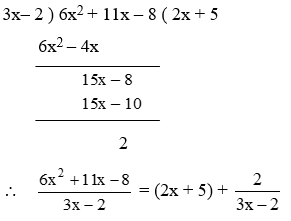
Example 7:Establish the identity
\(\frac{6{{ten}^{2}}+11x-8}{3x-2}=\left( 2x+5 \right)+\frac{2}{3x-2}\)
Solution:

2x 2 7x 6 Factor,
Source: https://www.aplustopper.com/factorization-of-polynomials-using-factor-theorem/
Posted by: allencouray.blogspot.com
0 Response to "2x 2 7x 6 Factor"
Post a Comment